A good retaining wall contractor in New London County, CT will spend more time talking to you about water than about blocks. That is the tell. Retaining walls in this part of Connecticut almost never fail because the soil behind them was too heavy. They fail because water got trapped behind the wall, froze, thawed, and pushed until something gave. If the person quoting your job is not walking you through drainage in plain language, you are being sold a wall that has an expiration date.

American Ground & Snow Management is family-owned in Mystic, we have been building hardscape across New London County since 2022, we are licensed and insured under CT HIC #0704425, and we were named Best of Eastern CT 2025. Every hardscape we build is backed by our 5-year hardscape warranty. This guide walks you through what to actually ask a retaining wall contractor before you sign anything.
Why Retaining Walls Fail in New London County
The soil around Groton, Mystic, Stonington, Ledyard, and inland toward Norwich has a habit that quietly destroys cheap walls. Rain and snowmelt saturate the ground behind the wall. That water has nowhere to go, so it sits. In January it freezes and expands. In February it thaws and refreezes. Every cycle nudges the wall forward a fraction of an inch. Multiply that by a few winters and you get bulges, cracked seams, blocks tipping out at the top, and eventually a wall that has to be torn out and rebuilt.
The weight of the soil is a real force, but modern segmental blocks and boulder walls are engineered to handle soil load. What they cannot handle without help is trapped water, called hydrostatic pressure. Every red flag on the list below traces back to that one problem.
The Six Things a Real Retaining Wall Contractor Will Build Into Your Wall
When you compare quotes, do not compare the sticker price. Compare what is going behind the wall where you will never see it. A qualified retaining wall contractor should be able to walk you through all six of these without hesitation.
1. Drainage Stone the Full Height of the Wall
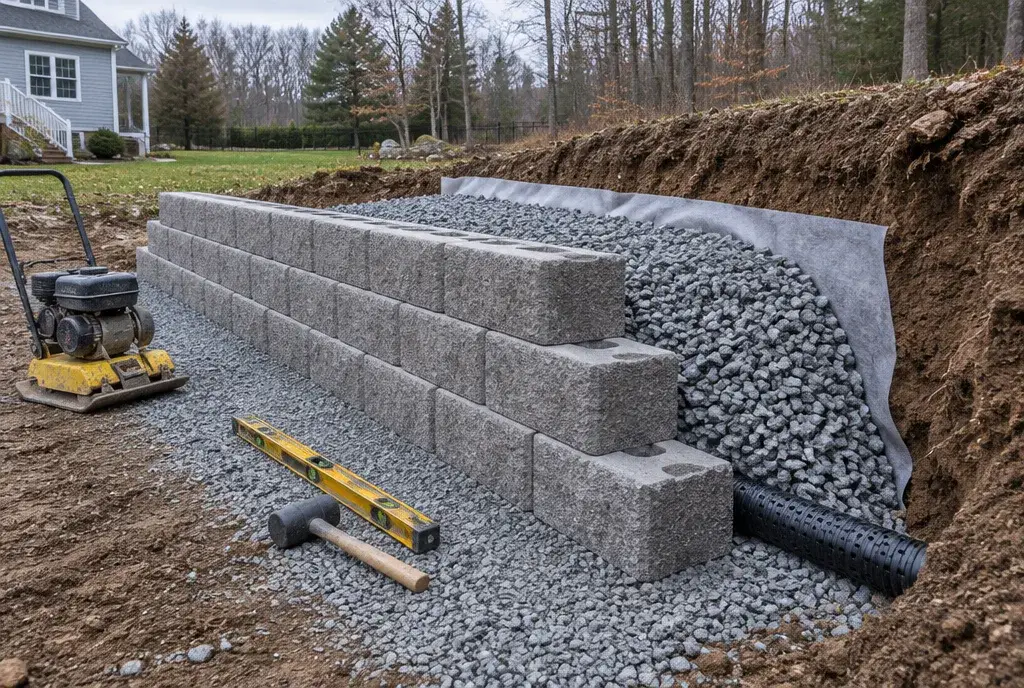
Behind the wall there should be a column of clean 3/4 inch crushed stone that runs from the base all the way up to just below the finished grade at the top. Not a thin ribbon. Not just at the bottom. The full vertical height. That stone column is what gives water somewhere to go instead of pressing against your blocks.
2. A Perforated Pipe That Actually Daylights
At the base of that stone column, buried in it, should be a 4 inch perforated drain pipe wrapped or bedded so it does not silt up. The pipe has to exit somewhere lower than where it starts, called daylighting. If the pipe just ends in the middle of the wall, or terminates in a spot that fills with water and freezes, it is not draining anything. Ask exactly where the pipe exits. Walk the property with the contractor and have them point at it.
3. Filter Fabric Between Soil and Stone
Non-woven geotextile filter fabric wraps around the drainage stone and separates it from the native soil behind it. Without that fabric, silt and clay wash into the stone column over a few seasons and clog it. Clogged stone stops draining. Once the stone stops draining, you are back to hydrostatic pressure and a wall that starts moving.
4. A Properly Compacted Stone Base
Under the first course of blocks, the base is either 3/4 inch crushed stone or processed gravel, at least 6 inches deep for shorter walls, deeper as the wall gets taller. It has to be compacted in lifts with a plate compactor, not just raked flat. If the base settles unevenly, everything above it moves.
5. Geogrid Reinforcement on Taller Walls
Once a wall gets above roughly 3 to 4 feet, or if it is holding back a slope, a driveway, or a patio, it needs geogrid. Geogrid is a synthetic mesh laid between courses of block and extended back into the soil behind the wall. It ties the wall and the soil mass together so they resist movement as one unit. Skipping geogrid on a tall wall is the single most common corner a cheap bidder cuts, and the one that causes the most spectacular failures.
6. Permits and Engineering for Tall Walls
In most New London County towns, retaining walls over 4 feet in exposed height (measured from the bottom of the footing to the top of the wall) require a building permit and a stamped engineered design. Walls that are terraced, holding back a driveway, or supporting a structure often trigger engineering at lower heights. A licensed retaining wall contractor will know your town’s threshold, pull the permit, and provide the engineered drawings. An unlicensed installer will tell you it is not needed.
Red Flags in a Cheap Retaining Wall Bid
Now that you know what should be in a wall, you can spot a bid that is missing the parts that matter. Watch for these:
- The quote does not itemize drainage stone, filter fabric, or perforated pipe. If it is not written down, it is not going in.
- The base is described as “we will dig a trench and set the blocks.” No mention of depth, stone, or compaction.
- The bid for a 5, 6, or 7 foot wall does not mention geogrid at all.
- No mention of a permit on a tall wall, or the contractor tells you permits are “usually not required” without checking your specific town.
- The contractor cannot show you a Connecticut Home Improvement Contractor number or proof of general liability insurance.
- The warranty is verbal, or is one year, or is limited to “workmanship” in a way that excludes the wall actually moving.
- The price is dramatically lower than the other two bids. On a retaining wall, cheap almost always means the drainage system was left out. You will pay for it in 5 to 8 years when the wall has to come down and go back up.
The Allan Block Best Practices for Segmental Retaining Wall Design, one of the industry standards used by engineers across the Northeast, is public and lays out the same drainage, base, and reinforcement requirements. If a contractor tells you those things are optional, they are arguing with the manufacturers of the blocks they are installing.
Questions to Ask Every Retaining Wall Contractor You Interview
Print this list. Ask all three of your bidders the same questions. The differences in their answers will tell you more than the difference in their prices.
- Are you licensed in Connecticut? What is your HIC number?
- What is your general liability insurance limit, and can you send a certificate?
- How deep is the base under the first course, and how will it be compacted?
- Will you install drainage stone the full height of the wall, wrapped in filter fabric?
- Where will the perforated drain pipe daylight?
- At what height do you start using geogrid? How far back into the soil does it extend?
- Does my town require a permit for this wall? Will you pull it?
- What does your warranty cover, in writing, and for how long?
- Can I see three walls you built at least 3 years ago that I can drive past today?
That last question is the honest one. A wall that still looks straight and clean after three New England winters is proof the drainage was built right. A three-year-old wall that is already leaning is proof it was not.
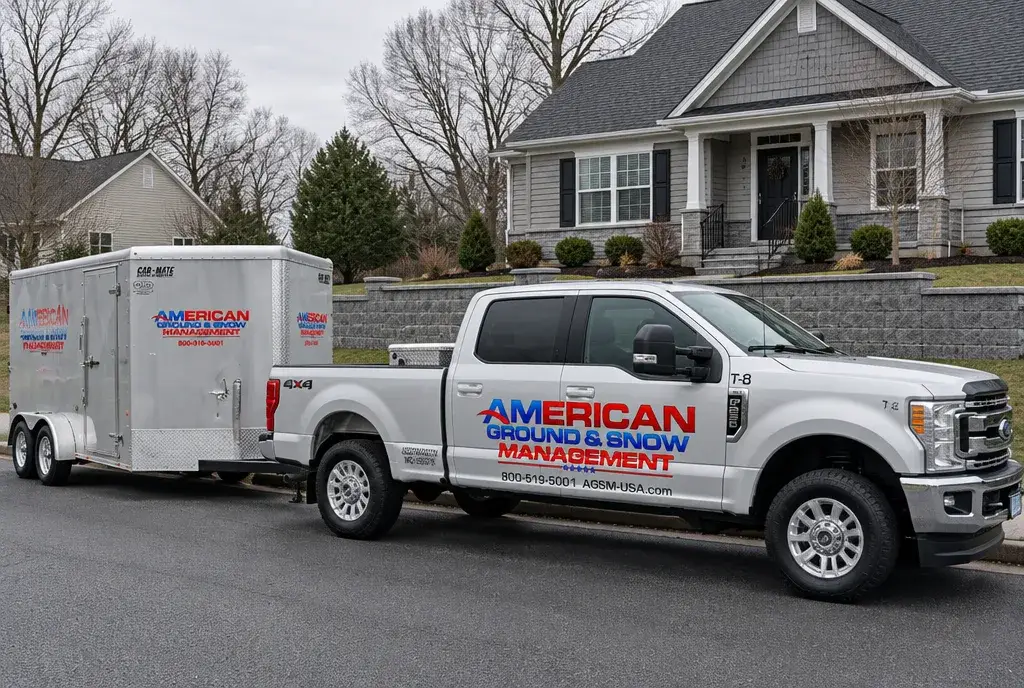
Our 5-Year Hardscape Warranty
Every retaining wall American Ground & Snow Management builds is backed by a written 5-year hardscape warranty. That warranty exists because we build the six things above into every wall as a standard, not an upgrade. When you build it right the first time, standing behind it for five years is not a risk, it is just the natural outcome.
Retaining walls are one part of a larger property picture, and if you are already thinking about a wall, you may also be thinking about the patio, walkway, or plantings that go with it. That is worth planning together up front. Our team also handles paver patios, walkways, seating walls, and full landscape design, so grading, drainage, and finished surfaces can be coordinated on a single visit. If you want a broader view of how we approach outdoor projects and property care across the region, our background and service philosophy is a good starting point.
Ready to Get a Real Quote on Your Retaining Wall?
If you are in Groton, Mystic, Stonington, Ledyard, Norwich, Pawcatuck, Gales Ferry, or anywhere across New London County, we will come out, walk the site with you, look at the grade and the drainage, and give you a free on-site quote that itemizes exactly what is going into your wall. No pressure, no upsell, no vague numbers.
Call American Ground & Snow Management at (860) 980-1129 to schedule your free retaining wall quote. Family-owned. Licensed and insured. CT HIC #0704425. Backed by our 5-year hardscape warranty.