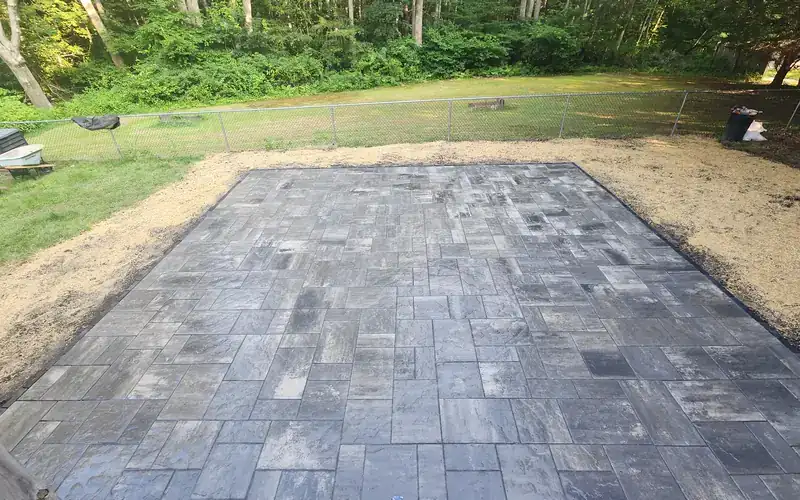

Take the back of the property back.
Land clearing in Mystic CT and across southeastern Connecticut. Brush hogging, overgrowth removal, stumps and regrading, for the acre you stopped walking on years ago.
Got it.
Your request is in. Someone will reach out within one business day. Need us sooner? Call (860) 980-1129.
Nobody let this happen. It just took eight years.
Almost every overgrown acre in this county went the same way. The back fence line stopped getting walked, bittersweet came up the trunks, multiflora rose filled in underneath, and within a few seasons there was no way in. By then it is a land clearing job rather than a weekend.
Then it stops being cosmetic. Bittersweet is heavy enough to pull limbs off a mature oak in wet snow. Barberry thickets hold humidity at ground level and are a documented tick reservoir, which is why the back of a property can be worse to walk than the woods behind it.
The good news is that a week of machine time undoes ten years, and it does not come back the same way provided the follow-up gets done.
Same garden. Same shed. About a third more property.
The trees worth keeping stayed. Everything strangling them did not, and the stone wall turned up underneath. Drag the handle across to see it.
Drag left and right to compare.
Clearing is not one service, and the wrong one is expensive.
People ring up asking about land clearing and mean four different things by it. Here they are in order of how far down you go, because each costs more than the last and plenty of properties only need the first.
Brush hogging
A rotary cutter run over everything at ground level. Knocks down tall weeds, briars and saplings and leaves the cuttings to break down. By far the cheapest way to get an area back under control.
Right when: you want a field, meadow or back acre walkable and mown once a year, and you are not building anything on it.
Brush and land clearing
The full removal. Trees, shrubs, vines and scrub taken out rather than mown down, and the debris hauled off rather than pushed into a pile in the corner for you to look at.
Right when: you want the area genuinely open and usable, or you are reclaiming a treeline, fence line or view.
Stumps and grubbing
Stumps and root mats out of the ground rather than cut flush. The step people skip and then regret, because a stump left in place is a mowing obstacle, a trip hazard, and somewhere for the lot to resprout from.
Right when: anything is going on top afterwards. Lawn, paddock, driveway, patio, shed pad, septic.
Regrade and restore
Machine work leaves ruts and holes. Regrading pulls the ground back to a shape water runs off, then it gets seeded so you end up with a surface rather than a scar.
Right when: you want to walk away from it finished. See lawn installation for the seeding side.
What you are actually standing on when the machines leave.
This is the conversation that goes wrong most often in land clearing, and it goes wrong at the end rather than the beginning. Cleared does not mean flat, and flat does not mean buildable. Here is each stage stated both ways.
Land clearing in Mystic CT runs into things a national outfit would not think to ask about.
Glacial ground with three hundred years of farming on top of it. That combination produces five recurring surprises, and knowing them in advance is most of what a local crew is worth.
There is rock under there
Buried fieldstone, boulders and shallow ledge are the normal condition here, not bad luck, and they are the biggest reason a grubbing price moves once machines are in the ground. We flag on the walk where we expect to hit it. That argument belongs on a clipboard, not an invoice.
Wetlands are a town matter, and they are strict
Connecticut regulates wetlands through each municipality's own commission, and the regulated area extends beyond the wet ground itself. Clearing inside that upland review area without a permit is a real problem, not a technicality. If your site may fall inside one we will say so before anything starts. Start with Connecticut DEEP.
Cutting knotweed spreads it
Knotweed regrows from fragments of root and stem, so mowing a stand and driving the machine on through the property is how one patch becomes six. It gets identified and handled separately. Bittersweet, multiflora rose and barberry all resprout hard too, which is why follow-up matters as much as clearing.
The stone walls stay
Half the properties in this county have a colonial field wall in the brush somewhere, and uncovering it is often the best part of the result. Walls do not get bulldozed, driven over or used as a push pile. If one turns up mid job, work stops and you get told.
Timing changes the damage
Machines on saturated spring ground leave ruts you then pay to regrade. Frozen and late fall ground carries equipment far better, sightlines open up once the leaves drop, and the ticks are quiet. If it is not urgent, waiting is usually the cheaper decision.
You know the stage before we start.
Every land clearing quote names which of the four stages it takes you to, where the boundary of the work is, what happens to the debris, and what we expect to find underground. If something changes the price, work stops and you get a call, not a bigger invoice at the end.
Send a photo. We will tell you what it needs.
Most land clearing in Mystic CT starts with a photo and a rough idea. We walk it, mark the boundary of the work, say which of the four stages your goal actually needs, and price it there. Often it is one stage less than people expected, and occasionally it is one more.
Free site walk · the stage named in writing · debris hauled off, not piled in the corner
Straight answers about land clearing in Mystic CT.
What does an acre cost to clear?
There is no per acre number for land clearing that means anything. Two acres of light brush and two acres of mature scrub over buried stone are not the same job, and the stage you stop at moves it again.
Do you take the debris away?
Yes. It leaves the property rather than becoming a pile you look at for two years. If you want chips kept on site for trails or beds, say so and we will leave them where you want them.
Can I keep some of the trees?
Yes, and on most jobs you should. Selective clearing takes the scrub and the strangling vines and leaves the mature specimens standing. We mark what stays before anything starts.
Will it just grow back?
The woody invasives will try, because bittersweet, multiflora rose and barberry all resprout from the root. What stops it is keeping the area mown, or putting it on a maintenance visit. Clearing without a plan for year two is how people pay twice.
Do I need a permit?
Sometimes, and it depends on your town rather than on us. Work near wetlands goes through the municipal Inland Wetlands Commission. If your site looks like it might, we tell you to check before anything starts.
Can you grade and seed it afterwards?
Yes, and that is the reason to use one company. Clearing, regrading and seeding are one job in three parts, and handing the second part to someone who was not there for the first is where the finger pointing starts.
Do you do commercial sites?
Yes, including HOAs, and commercial runs across the state rather than just the shoreline. Brush hogging, clearing and site work for parking, storage, sightlines and fire access are all standard.
More on getting a property back in shape.
What actually goes wrong on southeastern Connecticut properties, and what it takes to put it right.

Winter Prep for a Downtown Mystic Property With No Driveway
On a historic district lot there is no driveway to plow and nowhere obvious to put the snow. Winter here is planned in October, not reacted to in January.

Groton or Stonington? Which Town You Deal With for Ground Work in Mystic
Mystic is a village split between two towns, and the river is the line. It decides which building department and which wetlands commission you deal with.

Salt Damage on Mystic Shoreline Plantings: What Actually Survives
Shrubs that browned off in March were not killed by cold. They were killed by salt. Here is what survives on an exposed Mystic property and what never will.