Licensed & Insured Best of Eastern CT 2025 Family-Owned Since 2022
Open Mon-Fri, 9 to 5
AGSM crew salting and checking a walkway for refreeze after a storm in Mystic, CT
Now Booking Snow
Limited snow routes. Reserve your spot before the first storm.
Snow & Ice Service
Licensed & Insured Best of Eastern CT 2025 Since 2022
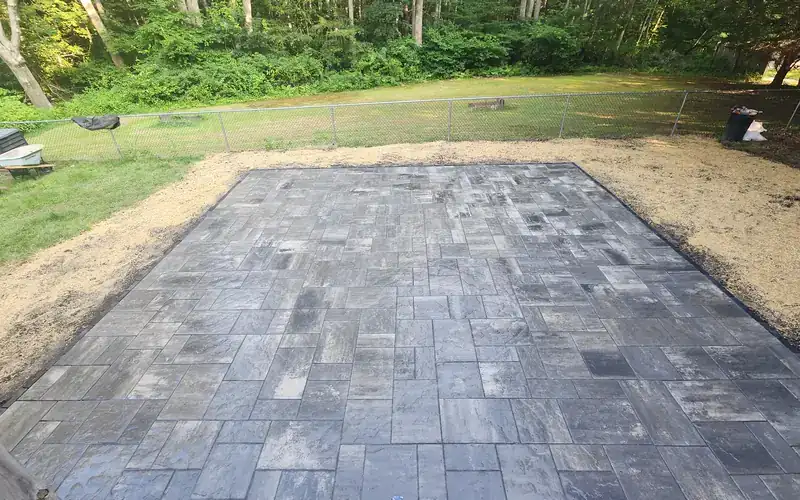
Finished paver patio with a soldier course border, one of our paver patios in Mystic CT
Paver Patios

The part that decides everything is the part you never see.

Paver patios in Mystic CT and across the southeastern shoreline. Built on a base deep enough for a Connecticut winter, and backed by a five year hardscape warranty.

5-year hardscape warranty Licensed & insured Free site walk
(860) 980-1129Prefer to talk? Call or text
Paver Patios
Get Your Free Quote
Tell us roughly what size and where. We reply within one business day.
No spam. No pressure. Reply within one business day.
Licensed & Insured · Free, no-obligation quote

Got it.

Your request is in. Someone will reach out within one business day. Need us sooner? Call (860) 980-1129.

Why patios fail

Nobody’s patio ever failed because of the pavers.

The paver is a lump of pressed concrete. It is essentially indestructible and every contractor buys it from the same yards. What separates a patio that is still dead flat in fifteen years from one that is dipping and lipping in four is entirely underneath it, where you cannot inspect it and cannot photograph it.

That is an uncomfortable thing to be buying. You are paying five figures for a surface, and the part you are actually paying for got buried before you saw it. Which is why the only sensible thing to do is read the base spec before you sign, and why ours is published below rather than described as top quality materials.

Connecticut makes this sharper than most places. We go through dozens of freeze and thaw cycles a winter, and every one of them is water in the base looking for a way to lift your patio.

Failed paver patio holding water with settled uneven pavers and weeds through the joints
Settled in the middle, holding water, weeds through open joints. None of that is the paver’s fault.
What is under it

Our base spec, from the bottom up.

Read this against any other quote you are holding. If a quote does not tell you the excavation depth and the compacted base depth, it is not a specification, it is a price.

1½″Wearing course

Pavers and edge restraint

Laid to pattern with a soldier course border, then locked at the perimeter with spiked edge restraint. Without that the outside row walks outward and takes the rest with it.

1″Bedding

Screeded bedding layer

Coarse bedding sand screeded dead flat between rails. One inch, not three. A deep sand bed is not a cushion, it is a place for the surface to move.

6 to 8″The whole job

Compacted crushed stone base

Angular processed stone placed and compacted in three to four inch lifts, never dumped and rolled once. This layer carries the load and drains the water, and it is where the price difference between two quotes usually lives.

FabricSeparation

Geotextile over the subgrade

Fabric between soil and stone so the two never mix. Without it the fines migrate up into the base over a few winters and the base quietly stops being a base.

2%Fall

Subgrade, compacted and pitched

Excavated to depth, compacted, and cut to fall away from the house at about a quarter inch per foot, so water leaves the surface instead of standing on it.

Compacted stone base and screeded bedding sand under one of our paver patios in Mystic CT
Stone base in, sand screeded between rails, pavers advancing. This is the photograph worth asking any contractor for.
Driveways and anything a vehicle touches go deeper. Six to eight inches is the pedestrian patio spec. Under a driveway it is ten to twelve, and a contractor who quotes you the same base for both has told you something important about the rest of the job.
Pavers, stamped or poured

In this climate the joints are the feature, not the flaw.

The three ways to build a patio behave completely differently after ten Connecticut winters. This is the honest version of a comparison we obviously have a side in.

What we build

Concrete pavers

Thousands of small units with joints between them, so the surface flexes with frost instead of fighting it. If something does settle, that section lifts out and goes back down. Nothing has to be demolished.

Downside: joints want re-sanding every few years and weeds will find any that are left open.

Alternative

Stamped concrete

A single poured slab textured to look like stone. Lower cost, no joints to sand, and genuinely attractive on day one. It is one rigid piece, so frost movement has to go somewhere.

Downside: when it cracks the crack runs through the pattern, and a repair never disappears.

Alternative

Poured concrete

Plain slab. Cheapest per square foot, hard wearing, and completely fine for a utility area, a shed pad or a service walk where appearance is not the point.

Downside: the same rigidity problem, and it reads as utility rather than as living space.

Built the same way, same base spec
Walkways Outdoor steps Seating walls Retaining walls Fire pits Patio extensions
Five things about hardscape here

What paver patios in Mystic CT have to put up with.

Freeze and thaw is the one that decides everything else on this list.

Freeze and thaw, dozens of times

A Connecticut winter cycles above and below freezing again and again, and every cycle is water in the base expanding. That is the entire argument for a deep, free-draining, properly compacted base. In a warm climate a thin base gets away with it. Here it does not.

Water goes first, patio second

If the ground around the patio holds water, the base will too, and no spec survives that. Drainage and grade get sorted before a single paver is laid. Building a patio on ground that floods is the most expensive way to find out about it. See drainage if the area already holds water.

Edge restraint is not optional

The outside row is the only one with nothing holding it sideways. Spiked restraint buried at the perimeter is what stops the whole field creeping outward over a decade, and it is one of the first things cheap quotes leave out because nobody can see it.

Joint sand is maintenance

Polymeric sand locks the joints and resists weeds, but it is not permanent. Expect to re-sand every few years, sooner on a patio that gets pressure washed hard. That is normal ownership, not a defect.

Near the water, plan for salt and sand

Shoreline properties get de-icing salt in winter and windblown sand year round. Sealing is a choice rather than a requirement, and the honest note is that a sealed patio looks better and needs redoing, while an unsealed one weathers and does not.

Our commitment

Five year hardscape warranty.

Every hardscape we build carries it, and it is worth saying plainly that a warranty is only ever as good as the base under it. Ours is written against the spec above, which is why the spec is published rather than described. Utilities marked through Call Before You Dig, certificate of insurance before work starts, and the full warranty terms go over with your quote.

Jordan & CJ · Owners
Paver Patios

Bring the other quote with you.

Genuinely. Put it next to ours and compare the two on excavation depth, base depth and edge restraint rather than on the price at the bottom. If theirs is deeper than ours, take it. Most of the time the difference is four inches of stone nobody mentioned.

Free site walk · base depth written on the quote · five year hardscape warranty

5-year warranty Finished paver patio and seating wall behind a house in Mystic CT
Questions

Straight answers about paver patios in Mystic CT.

What does a patio cost?

Square footage is only the start of it. Access for machines, how many cuts the shape needs, steps, walls, and how much grading happens first all move the number. We measure and price the actual job rather than quote a rate per foot.

How long does it take?

A straightforward patio is usually several days on site. Steps, walls or significant grading first will extend it. Weather matters, since base cannot be compacted properly in standing water.

Will it sink?

Not if the base is right, which is the whole reason the spec above is published. If a section ever does settle, pavers are the one surface where the fix is to lift that area and reset it rather than demolish anything.

Do I need to seal it?

No. Sealing deepens the color and helps with stains, and it needs redoing every few years. An unsealed patio simply weathers. It is a preference, not a requirement, and we will not push it.

What about weeds in the joints?

Polymeric sand resists them but does not last forever. Re-sanding every few years keeps the joints tight, and anything growing through is usually seed landing on top rather than coming up from below.

Can you extend or repair what I already have?

Often, yes. Matching an older paver exactly is the hard part since ranges change, so an extension sometimes works better as a deliberate contrast. We will look at the existing base before promising anything.

Related reading

More on building outdoor space here.

What actually goes wrong on southeastern Connecticut properties, and what it takes to build something that lasts.

We use cookies

We use cookies to improve your experience on this website. You may choose which types of cookies to allow and change your preferences at any time. Disabling cookies may impact your experience on this website. You can learn more by viewing our Cookie Policy.