Short answer: it depends on how many leaves you have. A light layer can be mowed right back into the lawn. A heavy layer has to come off before the snow, either raked or removed. The mistake is treating every yard the same, because a lot under two big oaks and a lot with one young maple are not the same problem.
The simple test
Look down at the lawn. If you can still see grass through the leaves, you can usually mulch them with the mower. If the leaves cover the grass completely, or they are piled where the wind drifts them against a fence or the foundation, mulching will not keep up. Those leaves need to come off.
Option 1: mulch them with the mower
Mulching works on a thin layer. Run the mower over the leaves, ideally a couple of times, until the pieces are about the size of a dime and settle down between the grass blades. They break down over the winter and feed the soil.
- Do it early and often. Two or three light passes across October beats one heavy pass in November.
- Mow dry leaves. Wet leaves clump and mat instead of shredding.
- Stop when the shreds sit on top of the grass instead of falling into it. That is the sign there are too many.
Option 2: rake or blow them off
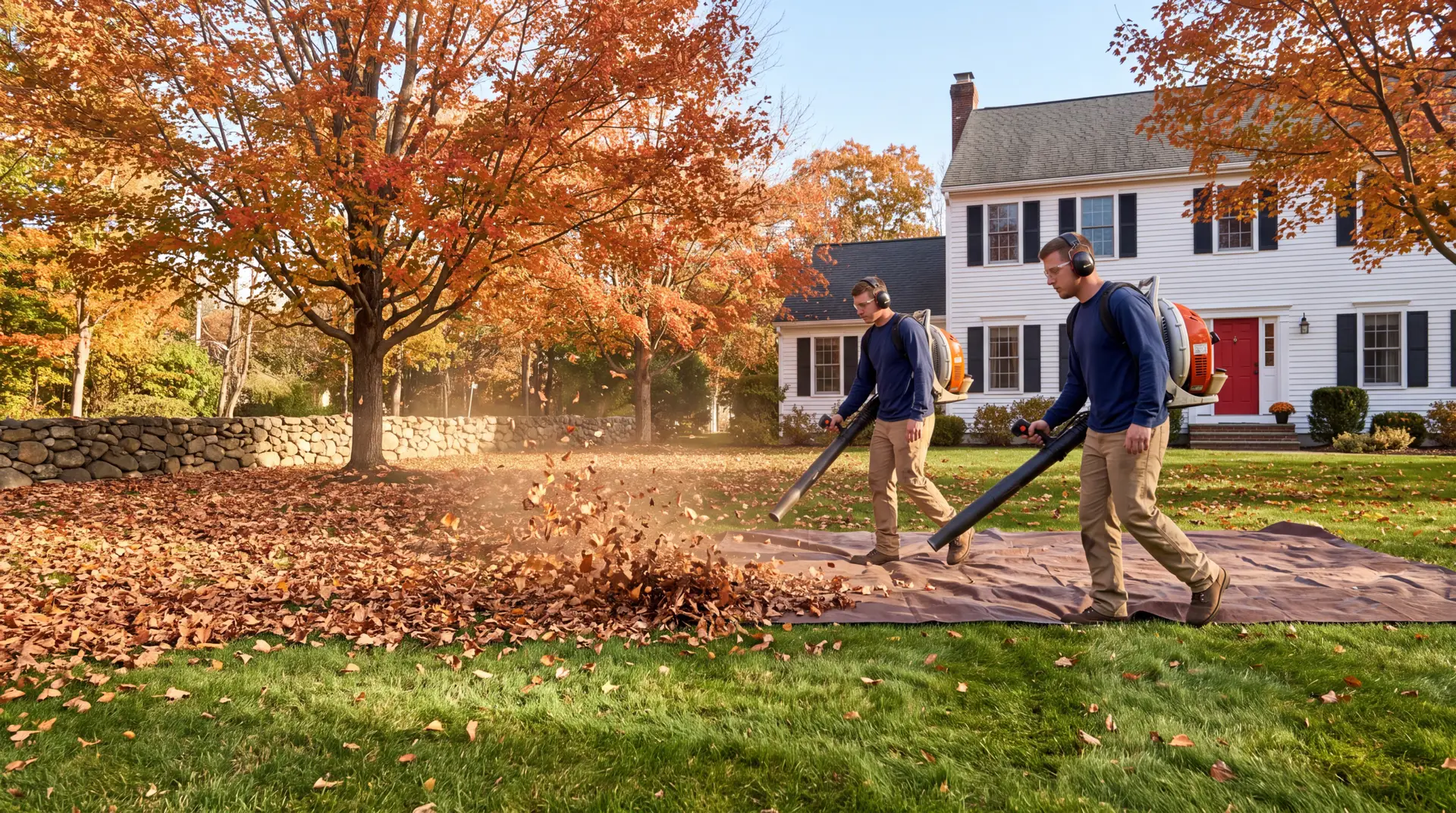
Once the leaves cover the turf, they need to come off. Wet, matted leaves seal the surface. The grass underneath cannot get light or air, and it thins out in patches shaped exactly like where the leaves drifted. A heavy leaf layer left under snow also gives gray snow mold a head start. The Connecticut Agricultural Experiment Station describes it as a common winter disease on lawns that stay covered for long stretches.
Raking gets the leaves off the lawn, but then you still have to deal with the pile.

Option 3: have them removed
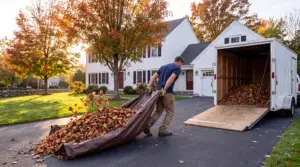
In Connecticut, leaves cannot go in the trash. CT DEEP lists leaves as a mandatory recyclable, so they cannot be sent to a landfill or an incinerator. That leaves three routes: compost them yourself, bag them for your town’s leaf pickup or drop-off, or have a crew haul them away.
Removal makes the most sense when:
- You have big oaks or a wooded edge and the leaves come down in feet, not inches.
- Leaves have blown into the beds and under the shrubs, where they mat the worst and a mower cannot reach.
- You do not have the space, or the weekends, to compost or bag a full lot.
What we see on southeastern Connecticut lots
Most properties in Mystic, Groton, Stonington and Ledyard need a mix. The open lawn can take some mulching in October. The beds, the fence lines and anywhere under the oaks need the leaves pulled out. And the oaks are the reason one cleanup is often not enough: they hold their leaves for weeks after the maples are finished, so a cleanup done too early gets buried again.
Quick answers
Is it OK to leave leaves on the lawn?
A thin layer you have mowed into small pieces, yes. A full cover of whole leaves, no. It blocks light and air and can kill the grass in patches.
Can I put leaves in the garbage in Connecticut?
No. Leaves are a mandatory recyclable in Connecticut. Compost them, use your town’s leaf program, or have them hauled to be composted.
When should leaves be off the lawn?
Before the first lasting snow. In New London County that usually means getting the last of them up in November, after the oaks have dropped.
Want the leaves handled?
An American Ground and Snow Management fall cleanup takes every leaf off the turf, pulls the leaves out of the beds and out from under the shrubs, cuts back the perennials, and blows the walks, drive and patio clear. The leaves leave with us, so there are no bagged rows at the curb. Oak-heavy lots often get two passes, because oaks hold their leaves for weeks after the maples are done.
We are family-owned in Mystic, licensed and insured (CT HIC #0704425), and named Best of Eastern CT 2025. See what is included on our spring and fall cleanups page, or call (860) 980-1129 for a free quote.
If you would rather not think about any of this next year, our Essential Care plan is weekly mowing with the same crew plus the spring and fall cleanups built in. Premium Care adds monthly bush and bed work: weeds pulled by hand, shrubs pruned in their window, and edges re-cut.